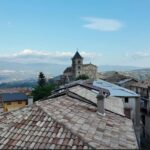
Live Cerisano in an unforgettable way by choosing one of our thematic packages.
Take part in weekends dedicated to art, music or traditional cuisine, and discover how the culture and beauty of the village can make your stay truly special.
Route 1 | Places of Culture

Cerisane is not only history and nature: it is also a place where the culture lives and renews itself, every day, among historic buildings, cozy squares and spaces dedicated to art, theater and music. The path The Places of Culture takes you to the discovery of the beating hearts of the cultural life of the village, where tradition and creativity meet to give voice to the territory.
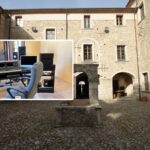
The path is part of the imposing Palazzo Sersale, elegant noble residence of the seventeenth century, today a symbol of the historical and cultural identity of the country.
Inside, in addition to the magnificent architecture, it hosts events, exhibitions, exhibitions and meetings. It is the reference point of the Cultural Cerisano, a living, open and constantly changing place.
From there we continue towards the House of Cultures, meeting and experimentation space, dedicated to workshops, artistic initiatives, projections, book presentations and activities for all ages. It is here that new ideas are born, that generations are confronted and that the cultural future of the village is built.
The path also touches the Historic squares, as Piazza Zupi, natural stage for concerts and outdoor shows, and privileged meeting places for citizens and visitors.
The squares of Cerisano have always been centres of sociality, where popular culture and contemporary art find home.
Among the most suggestive spaces are the ‘Outdoor amphitheatreSet between green and stone, during the summer it hosts cultural events, musical performances and theatre performances under the stars.
"The Places of Culture" in Cerisano are an invitation to walk and be inspired.
A path designed for those who love to know, listen, participate.
Route 2 | The way of taste

The way of taste, that is a path aimed at introducing typical shops and traditional cuisine Welcome along The Via del Gusto, an itinerary designed for those who want to discover the most authentic soul of Cerisane through its scents, its flavors and its historic shops.
This food and wine route will take you to the heart of the Calabrian village, between alleys and squares, where the culinary tradition is still preserved and handed down with passion.
The Via del Gusto is more than just a journey: it is a sensory and cultural experience. Entering the craft workshops, you will be able to meet local producers, discover ancient recipes, taste the bread cooked in wood, cold cuts seasoned according to the methods of the past, cheeses with a strong taste and preserves made with genuine ingredients of the territory.
There is no shortage of Traditional trattorias and taverns, where to taste typical dishes such as "raschiatelli" with sauce, "pitta" filled, baked goat meat, eggplants in oil, the mushrooms of Monte Cocuzzo and the sweets of the country tradition, such as "nepitelle" and dried figs stuffed. During the journey you can also stop in the small workshops where the craft wine and theextra virgin olive oil, testimony of the agricultural vocation and care for the land that characterize Cerisano for centuries.
The Via del Gusto is an invitation to slow down, to listen to the stories of artisans and restaurateurs, to find the link between food, people and the territory.
It is also an opportunity to bring along a piece of Cerisano: a taste, a perfume, a memory.
Route 3 | The Churches

The historic center of Cerisano is embellished by numerous churches, rich in works of art and testimonies of great historical and artistic value. Among them stands the Church of San Domenico, originally dedicated to Our Lady of Help. Inside there are important paintings, including a Madonna del Rosario of Salfi, a Saint Thomas Aquino signed by Giuseppe Santanna, and numerous paintings by the painter Rocco Ferrari of Montalto. The Parish Church of San Lorenzo Martire, of medieval origins, shows outside signs of architectural interventions dating back to the eighteenth and nineteenth centuries.
Inside you can admire four nineteenth-century frescoes by Giambattista Santoro, one Deposition by Raffaele Rinaldi of San Fili and one Visitation signed by Santoro himself in 1882. Of particular relief is also the 1927 canvas depicting the Blessed Ugolino da Cerisanodesigned by Paolo Vetri. In the left nave is the Chapel of the Rosary, probable original nucleus of the entire sacred building.
Inside, precious wooden stalls recall a seventeenth-century style, lost in a 19th-century fire, caused by the candles lit during the rites of Holy Week.
Other works include a wooden crucifix of the late seventeenth century and, in sacristy, a Crucifixion by Salvatore Santelli.
Another significant church is that of Carmine, built in the early seventeenth century, probably in response to the presence of the church of the Rosary, in a climate of historical rivalry. The building is enriched by two suggestive glass domes of the nineteenth century.
The portal and the round depicting the Madonna and Child are works of sculptor Salvatore Fiume. Inside are preserved paintings of Salfi, Angelo Mazzia and Giambattista Santoro.
The Church of Santa Maria degli Angeli, also known as Oasi Sant’AntonioThe convent of the Reformed friars of St. Francis of Assisi dates back to 1609.
Among the preserved works are a painting by Christopher Santanna, a wooden statue of the Immaculate of the eighteenth century, a wooden crucifix of the seventeenth century and some oils on canvas, two of which attributed to Santanna himself.
The façade, renovated in 1949, was preceded in the past by a portico leading to the cloister.
In the lower part of the village is the Church of the Schiucchi, whose origin, according to tradition, is Byzantine. At one time there was a precious table of Our Lady of Constantinople, also of probable Byzantine school, then lost. In later times, between the sixteenth and seventeenth centuries, a canvas with the same subject was made. The building has a simple facade, with a small portal and two windows, flanked by a bell tower.
Finally, the Matrice Church of San Lorenzo Martyr, which has undergone several renovations over time, thus assuming a composite architectural aspect. The façade, richly decorated, is characterized by a large portal framed by Corinthian pilasters and surmounted by the statues of San Lorenzo Martire, San Pietro and San Paolo. Next to the church stands an imposing bell tower, whose original cusp collapsed in the 1905 earthquake and was rebuilt in the 1920s.
During the restoration a fresco depicting San Rocco with the dog. The vault of the church is decorated with four frescoes by Giambattista Santoro, author of the oil on canvas Visit of St. Elizabeth, located near the entrance.
Route 4 | The way of the hermit

The Way of the Hermit Upon returning from a trip to Assisi, Francis matured the firm intention of becoming hermit and to have as their only dwelling a cave.
His life plan was to make a journey of spiritual asceticism, made up of prayer, fasting and penance.
As time passed, the area where the Sanctuary of Paola now stands began to become a destination for numerous pilgrims, eager to obtain, through his intercession, physical and spiritual healing. Francis’ ascetic rigor also attracted some young people who wanted to live like him and so the Order of the Minims began to come to life.
The fame of holiness of Francis and his hermits was spreading like a stain of oil, so much so that many urban centers demanded a convent under the rule of Minim religious in their city.
The Way: The Way of the Hermit was born with the intention of limestone the steps of Francis who, while maintaining his purpose of hermitic life, went from Paola a Paterno as Founder.
He was about 56 years old when, accompanied by Paolo Rendace – who will become a key figure in the history of the Order – Francis arrived in the small community of the Cosentine Serres. He was in the midst of spiritual maturity and with great determination devoted himself personally to the construction of the Church.
The Way is taken care of by"The Way of Saint Francis" who deliberately conceived the route in a two-way way because Francis travelled him several times, making the shuttle between the two convents.